
The challenge
Fusium is the combined business of three Québec foundries: Fonderie Saguenay produces grey and ductile iron in Chicoutimi, TMA produces aluminum and magnesium in Trois-Rivières, and Fonderie BSL produces carbon, stainless and high-alloy steels. The group concentrates on single parts, prototypes and short runs that mass-production foundries refuse to quote. The flow of opportunities needed to keep pace with production volume is substantial. Orders are won when the work is presented in person or recommended by one of its foundry experts. The company stays hard to find for the overseas buyer who starts with a simple online search.
Marketing is what Sarah Jane Trudeau, who runs inside sales for all three plants, gets to once every client request has been handled. A blog, a series of casting explainers and a brand new Instagram account sat waiting for hours nobody had. And every post crossed four people to get approved, over email and file links.
We are very busy and we manage marketing in-house. Since I am first and foremost responsible for inside sales, marketing remains a secondary responsibility I get to when my schedule allows.
The solution
Give Fusium the tools to run its own marketing: a system that reads the business first, from four alloy families to eight years of keyword work, and keeps the company's image its own.
Approvals run where the content lives
Every post carries its own comment thread, assignee and status, and the review request moves on to the next approvers. The chain that ran on email and shared folders now runs in one place.
Executives publish without opening the software
Sarah Jane drafts an idea and a visual, the post lands in the executive's queue, he adds his own words, and it goes out under his own name. In an industry where buyers trust the person who understands the metallurgy, that carries more than a logo.
A campaign built for one show
For a global trade show in Europe, Fusium wrote buyer profiles for a single division and one product line. The whole sequence went into the calendar weeks ahead, not in the days before travel.
That [approval] feature alone justified our decision to adopt Glowtify. With channels multiplying, managing and approving every post was becoming more and more demanding.
The results
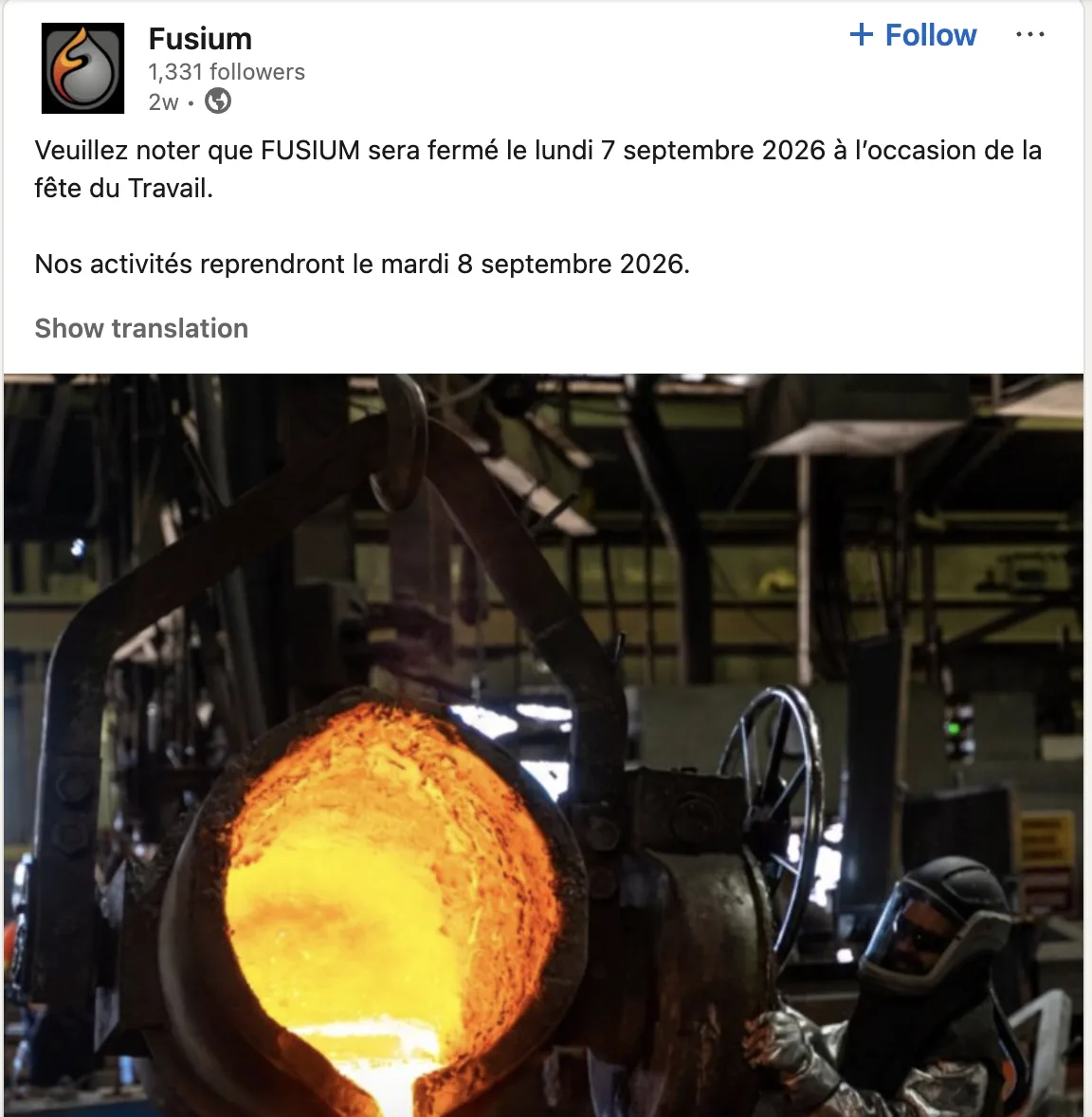
Fusium published its first piece in August 2026 and has held two to three pieces a week since: eight pieces as ten posts across LinkedIn, Facebook and Instagram, with a standard post moving from draft to published in one to five days. Two more are approved and scheduled. Sophie Dubuc, the sales assistant, now works out of the platform daily and calls Glowtify her “number one work tool.”
Views of Fusium's posts and pages went from 1,197 in the 30 days before the first post to 6,644 in the 30 days after. Published posts reached 2,607 people, and 7.5% of the people who saw them did something about it. The number Fusium runs its business on is quote requests, and it already tracks every click into the request-a-quote form. The coming show in Europe is where the two sets of numbers meet.
After that, eight years of paid keywords become published content on Fusium's own site. The searches the company already pays for start returning its own pages.
Glowtify gives us the equivalent of a marketing firm's services, with extreme efficiency, uncommon agility, and without the thousands of dollars in costs that usually come with them.