Marketing Team of One: 4 Strategy Pitfalls to Avoid
If you run marketing alone, staying “ahead” feels like an impossible feat.
The advice is almost always the same: publish more, add a channel, start a newsletter, get on TikTok, hop on a trend.
Do more. So you do, while your evenings (and results) disappear.
This is more common than you’d think: By one estimate, 78% of marketing teams are just one to three people, and 58.8% of B2B marketers say they've been asked to do more with fewer resources.
In small teams, jobs consist of dozens of specializations in one. Think: strategist, writer, designer, analyst, media buyer, community manager, and all of it lands on one desk. The instinct is to stay at your desk, keep typing, keep filming, keep editing, keep posting, keep sending. But it’s not working.
The teams that crawls out of this cycle with diminishing returns don't out-produce everyone around them. They do something simple in practice, transformative in nature: they make sure every single thing they do ladders up to a goal the business cares about. In other words, they work backward from a core business strategy.
The problem is the missing marketing strategy, not the missing hours
Fewer than half of B2B marketers have a documented strategy, according to the Content Marketing Institute. And the cost of that gap is weighty: in a 2026 study, 66.5% of content marketers said their single hardest problem was knowing where to allocate their time. Not a shortage of ideas, a shortage of clarity about which idea deserves their time and effort.
For a lean marketing team, an achievable plan is mission-critical. It’s what you go back to when fires are burning and you have 40 minutes to review an emergency press release, but you’ve also got deliverables for a tradeshow to get out the door by the end of the day.
Being invisible is costly, and it’s caused by being inconsistent
The stakes are getting higher as buyers shift. Forrester has long placed roughly 70% of the B2B buying journey happens before a vendor is ever contacted, a number that evolves every year as buying power shifts across generations. Across hundreds of conversations with businesses this year, becoming visible was consistently cited as the #1 goal of prospects we spoke to. (We built a set of new features to help solve this problem, get the full scoop here.)
Buyers increasingly open an AI assistant before a traditional search engine, and AI answers draw heavily on clear, informational content. These AI assistants are also crawling social media channels to pull information about your business, so a consistent beat of content won’t only grow your audience, but it will increase your discoverability across zero-click content.
The catch: scattered, last-minute approaches to content won’t get you there. The content that earns visibility is rooted in a thoughtful plan mapped to the questions buyers ask and the problems you’re uniquely fit to answer.
It takes time, but consistency breeds results: across businesses that have run a consistent, plan-driven program on Glowtify for at least a quarter, visibility has risen 51% year over year on average.
The 4 traps you’ll fall into when you don’t have a strategy in place
When there's no strategy aligned with your business, the same failure patterns repeat across nearly every solo and small team.
- The “just do more” reflex: Inconsistent results feel like an output problem, so you make more. But undirected volume just spreads the same forty hours thinner and buries the few pieces that were working.
- Every channel, scattered presence: Being everywhere is tempting, and it's the fastest way to do nothing properly. One person cannot sustain six channels, and a half-tended channel reads worse than an empty one. The way out is to pick where your buyers already are and commit to a cadence you can hold on your worst week, not your best.
- The seasonal scramble: Many lean teams go quiet, then panic-publish ahead of a buying season expecting results, then go quiet again. Buyers don't shortlist you in the two weeks you happened to show up. Presence is built in the slow months, before anyone is ready to buy.
- The fragmentation tax: The average solo marketer lives in a multitude of tools: a design tool, a scheduler, an email platform, a separate analytics tab, a generic chat tool for drafts. This fragmentation drains time, causes frustration from toilsome work, and makes it impossible to give your leadership team a full view on the work.
A marketing strategy and achievable plan to replace the chaos
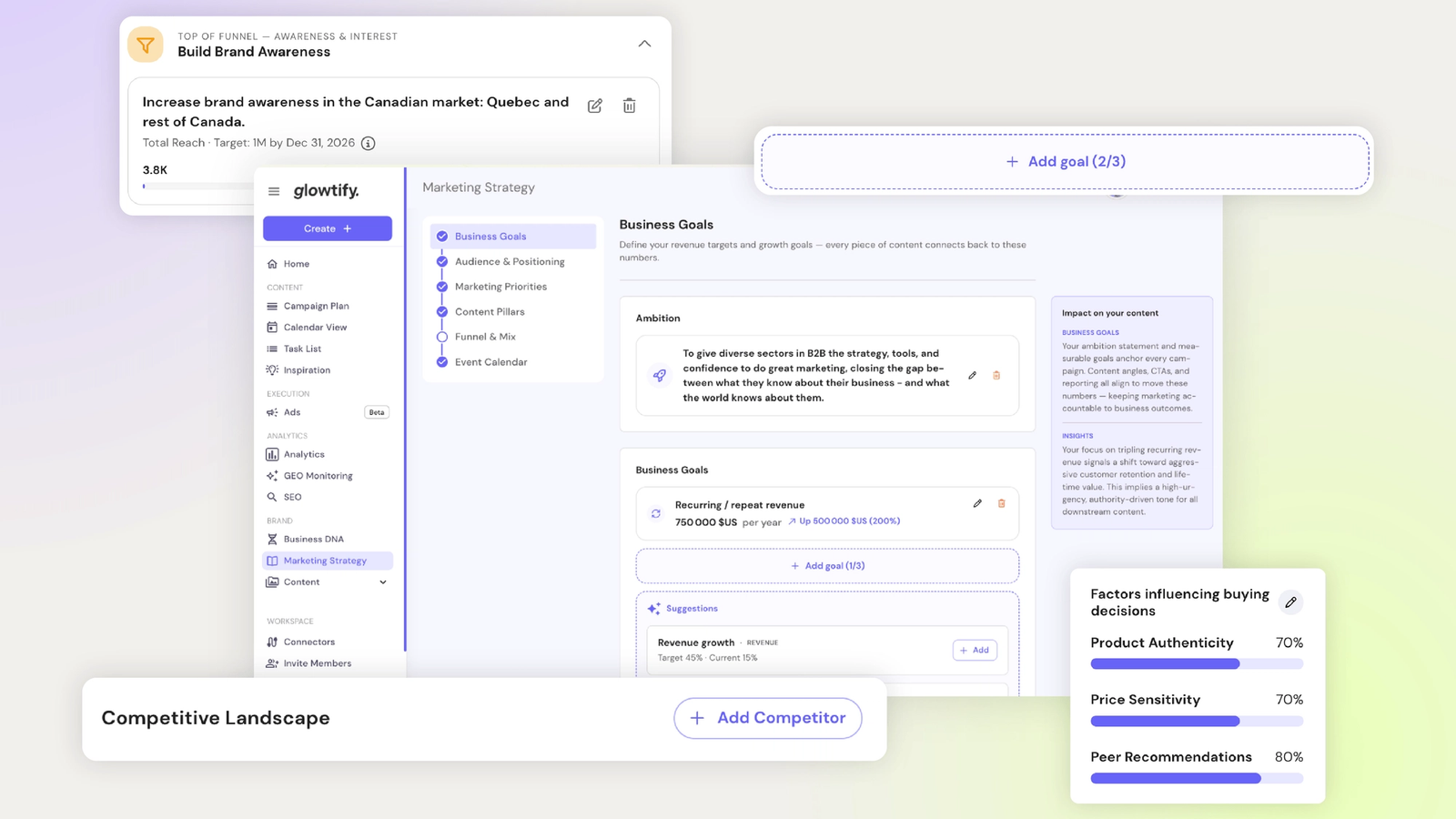
The fix is smaller than it sounds. You need a strategy that’s rooted in your Business DNA, mapped to the business goals your organization cares about most right now, that you can surface consistently (especially when prioritization discussions pop up.)
Five things to consider:
1. One or two business goals: Not "grow the blog", but a business outcome. Think: more calls coming to your office. A fuller hiring pipeline. Faster deal cycles. Getting found for relevant queries on ChatGPT. Everything you publish either serves that goal, or gets deprioritized.
2. Three core content pillars: These are the themes you want to be known for, based on your clear competitive differentiation, your audience’s preferences and needs. If you’re not sure where to start, get your sales team to record their next calls. See what questions customers are asking before they buy, and group them into themes. This is a foolproof starting point for content that will resonate.
3. A funnel split: Decide up front roughly how much effort goes to getting found, building trust, driving action, and keeping current customers. A workable lean-team split is about 60% top-and-middle funnel, 25% conversion, 15% retention. Functionally, this funnel split is the framework that stops you from running five promotional content pieces in a row, and then disappearing until the next time you hit the panic button.
4. Channels with a sustainable cadence: Choose two or three channels and a rhythm you can sustain. Then make one idea travel: a single piece on "how to choose X" becomes a blog post that earns search and AI-search visibility, an email to your subscribes, a social media carousel.
Just think about one idea, many formats, rather than inventing separate content for every channel. And if you're not sure where to focus, you're in the majority — it's the kind of call a system can make for you, recommending channels from what it knows about your business.
💡Fun fact: on Glowtify, “strategy recommendation” is the most-used part of our AI agent.
5. One metric for now, then grow: Pick a single number tied to the goal and hone in on how you can move the needle against that one: growth in overall visibility. The share of searches where you appear. Even something as plain as the percentage of your planned content that ships.
That last metric matters more than it looks. When a system is built to publish — not just to generate — content stops dying in a drafts folder: across Glowtify, roughly 82% of what the AI drafts gets published.
B45 Baseball, a ten-person Quebec bat maker with no dedicated marketer, is one example. They had the expertise and the assets, but before they had a plan and a system to run it, they were publishing roughly one in ten of the content they'd already paid to create. Once the plan was in place, that climbed to nearly 100%, and they produced 63 pieces across five channels in a single quarter. Read the full case study here.
An AI marketing system to accelerate the plan
Getting the plan in place is step one. But what comes next is the tough part for small teams: Executing it every week, across blog, email, social, and ads, in a voice that sounds like you (while you do your four other jobs) is where lean teams slide back into the scramble.
That's the gap Glowtify was built to close, and it starts before any content is made. Business DNA captures a company's mission, voice, audience, and guardrails first, so what comes out reads like the business instead of a generic draft. The Marketing Strategy layer turns that into a one-page plan in practice, including pillars tied to funnel stages, a format mix, a cadence for each channel, and the work runs from a single content calendar rather than five disconnected tools, with marketing advisors on hand when a human call is needed.
The aim isn't another tool to manage. It's making sure the plan you wrote sees the light of day, week after week.
The businesses that build the world deserve to be seen. For a team of one, getting there has never come from doing more. It comes from deciding what matters, writing it down, and having something dependable carry it out. See this built on your business: your pillars, your channels, your voice in Business DNA, and where you currently show up (or don't) in AI search.