Content Pillars: How to Choose Yours and What to Publish
Table of Contents
Content is one of the most effective ways to attract, engage, and influence consumers online. The challenge is that not all content is created equal.
So while it’s easy for marketers to create content on any topic—particularly with the advancement of AI tools like ChatGPT—it’s high-quality and relevant content that your customers need and want.
According to the Content Marketing Institute’s 2025 B2B research, content marketing is vital for marketers, with 87% reporting it helped increase brand awareness, 74% generated demand or leads through content, and 49% directly attributed revenue growth to content marketing efforts.
The same research found that 58% of B2B marketers rate their content strategy as only “moderately effective.” Among those who don’t rate it highly, the top reasons include a lack of clear goals (42%), a strategy that isn’t tied to the customer journey (39%), one that isn’t data-driven (35%), and ineffective audience research (29%).
Time is the other problem. In CMI’s 2026 B2B research, 39% of marketers named resource constraints (time, people, and budget) as one of their biggest content challenges. If nobody on your team does marketing full time, a short list of set topics means you are not starting from scratch every time you sit down to write.
This is why marketing leaders need to be strategic about their content marketing efforts. It’s not about having content on every channel; it’s about creating and sharing valuable, relevant, and consistent content tailored to your target audience.
If marketing is one of several jobs you juggle, and nobody on your team does it full time, this guide will show you how to choose a few core topics and what to publish under each one.
What a Content Pillar Is
Content pillars are the themes or topics that form the framework of your content marketing strategy.
Each pillar should be a core topic that’s relevant to your business and will help promote your products or services and values.
Think of content pillars as a scaffold that you build everything on. Each layer of content you add should have a purpose that’s always linked back to the core theme to make the structure (and your content) stronger.
The aim of using content pillars is to give your audience in-depth information on key themes and topics. This will not only provide value to prospects and customers but also build your credibility to become a thought leader in a particular area.
Why Are Content Pillars Important?
Content pillars help organize and optimize your content. No matter how good your keyword research is, it’s challenging to cover every word and phrase that your audience searches for.
Just think about the rise in popularity of voice search using smart devices and how Google is prioritizing AI-generated searches (AI Overviews) over organic and even sponsored content.
By creating content pillars, you can create content that covers all bases to offer your audience all the information they need on that topic.
The other important factor in having content pillars are they help to:
- Boost organic traffic
- Engage your audience
- Drive high-intent conversions
- Leverage Google’s Experience, Expertise, Authoritativeness, and Trustworthiness (E-E-A-T) ranking factor
- Attract quality backlinks
- Link to relevant internal content
How to Choose Three to Six
When marketing isn’t anyone’s full-time job, a good content strategy focuses on only three to six areas that matter most to your audience. You do not need to cover every possible topic at once. First, list the topics you want your business to be known for. Then, compare the topics with your business goals, customers’ needs, and existing content. If you have six topics, choose only three that have the strongest connection to your business and audience. Set aside the remaining three for the future instead of creating content for all six right away.
The simplest version is three pillars, one for each stage of the buyer’s journey: one that helps new buyers find you (awareness), one that helps them compare their options (consideration), and one that shows you deliver (conversion). That is a complete starting set. Add a fourth or fifth pillar only once you are publishing consistently on the first three.
Now, get to know the different types of content pillars and their purpose:
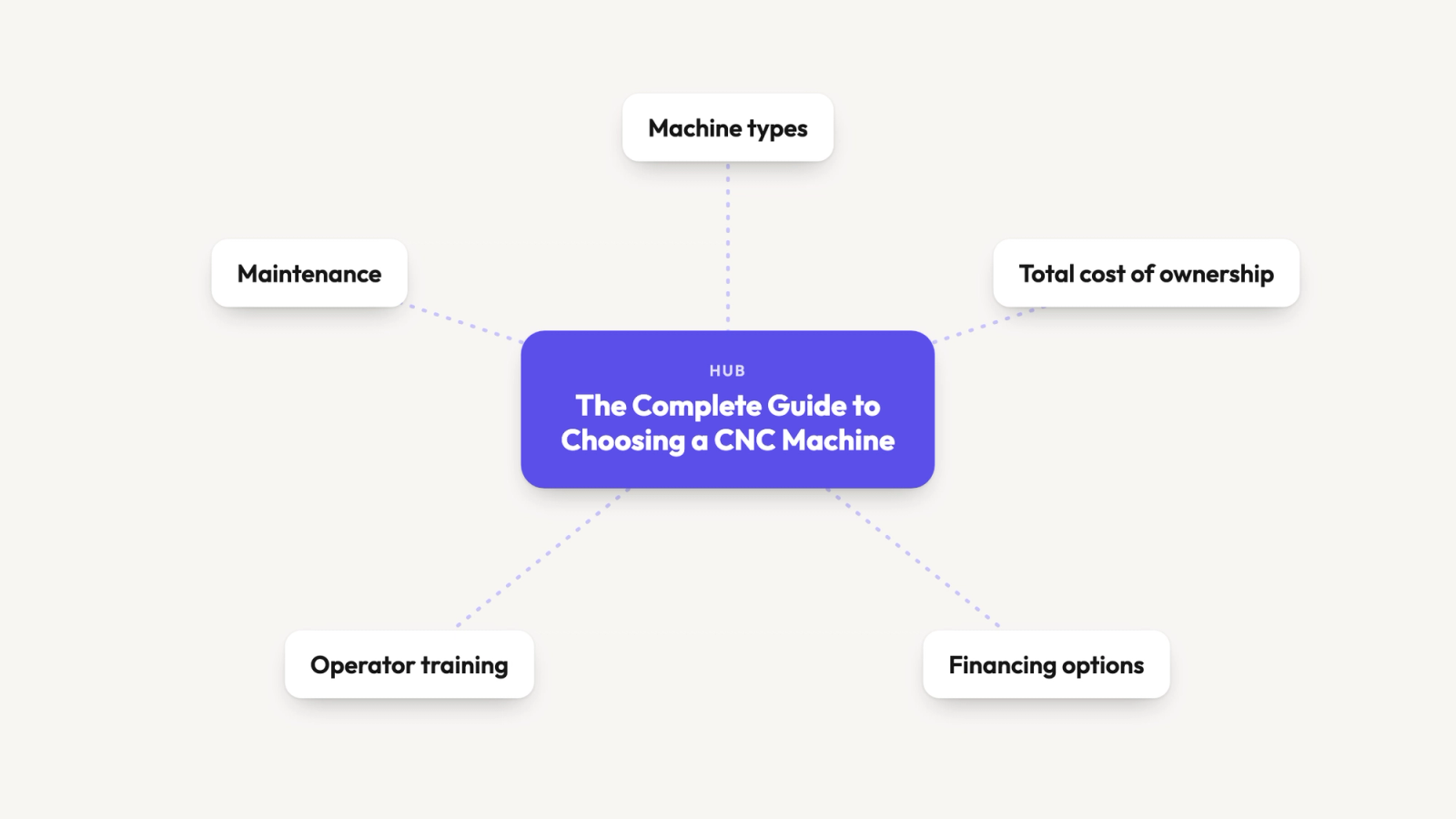
- Authority or guide pillar content: This type of content provides an overview, 101, or beginner’s guide to the topic. What this means is that you can have a hub piece of content and build out spokes that go into more detail to build on the topic. For example, let’s say you manufacture CNC machines. A hub piece of content could be ‘The Complete Guide to Choosing a CNC Machine for Your Shop’.
- Definition or What-is Pillar content: The focus for this pillar content is on discoverability. You want to create content that unravels so every aspect of the content is covered in detail. This can be beneficial for buyers who are new to a category and want to understand their options, and you can be the go-to for that information. Building on the CNC machine example, the hub piece here could be ‘What Are the Different Types of CNC Machines, and Which One Fits Your Production Needs?’
- How-to pillar content: The content you create here would have the goal of acting as a manual or helping a customer solve a problem or task. It can be a step-by-step guide, which is suited to video content as tutorials work well. The hub content here could be ‘How to Cut Machine Downtime with a Preventive Maintenance Schedule’.
With these in mind, let’s now look at how to create content pillars.
#1 Know Your Audience
There’s no point creating content if you don’t know who it’s for! If you don’t already have buyer personas, then you need to create them. Do your research and gather relevant data across all channels to figure out who your target audience is. Don’t just focus on demographics like age, gender, and location. Get down to the nitty-gritty and look at people’s interests, pain points, and goals.
#2 Look At What’s Performed Before
Existing content and campaign performance can tell you a lot about what resonates. Look at your top-performing blogs or social media posts to see what people engage with. See if there are any patterns or keywords and key phrases that your audience seems to be looking for. Then use these insights to inform and craft your content pillars.
#3 Pick Your Pillar Topics
With your audience in mind, narrow down your core topics to three to six pillars. More than that and you risk trying to cover too much ground and diluting your content. Make sure the topics or themes you choose are relevant to your business, brand values, and mission.
If you have several possible topics, ask your team if they can create useful content about each one regularly. A good pillar should give your team enough room to create different articles, social posts, guides, and other formats without repeating the same idea.
#4 Research Keywords
With new content pillars selected, it’s time to do your keyword research. Don’t rely on what’s gone before. Research and identify keywords with fresh eyes so you can really dive into each topic to provide valuable information and also start your journey to being an authority in each area. Tools like AnswerthePublic or Google Keyword Planner are good places to start. Make sure to factor in search volume and keyword difficulty to know how easy or difficult it will be to rank as part of your SEO content marketing efforts.
#5 Lay Out a Pillar Plan
With your content pillars in place and armed with keywords, it’s time to map out the structure of each one. Think of it like a spider map where you have a hub piece of content and then several spokes that explore the topic in more detail. For the CNC machine manufacturer, the hub could be the complete buying guide, with spokes on machine types, total cost of ownership, financing options, operator training, and maintenance.
#6 Audit Existing Content
Don’t forget about your existing content when it comes to content pillars. With clarity over the direction of your content, it can be easy to tweak or update existing content (particularly top-performing content) to fit into the pillar structure. Alternatively, look at content that may not be serving this new strategy and either edit, hide, or redirect.
#7 Create Your Content
You should now have everything you need to create content that feeds into your pillars. Don’t focus on one content type either. Make sure you have a mix of formats such as blogs, videos, or infographics to drive engagement. Remember to also be creative and inject some personality into the content.
#8 Develop a Linking Structure
With each piece of content you publish, ensure you include internal links to build a scaffold. Link each spoke to the hub page so that the content is connected using clear anchor text. Your audience will appreciate the depth of knowledge and so will search engines when it comes to SEO rankings!
#9 Share Content
Now that a lot of hard work is done, it’s time to share what your team has created. Use the channels that have been most successful in the past and see what happens to the metrics. It’s also worth considering new channels if the content lends itself to it.
A Worked Example: How We Chose Ours
Choosing a content pillar is easier if you keep the process simple. If marketing is something you fit in around your main job, do not try to come up with as many topics as possible. Instead, focus only on the areas that are relevant to your business, useful to your audience, and aligned with your content goals.
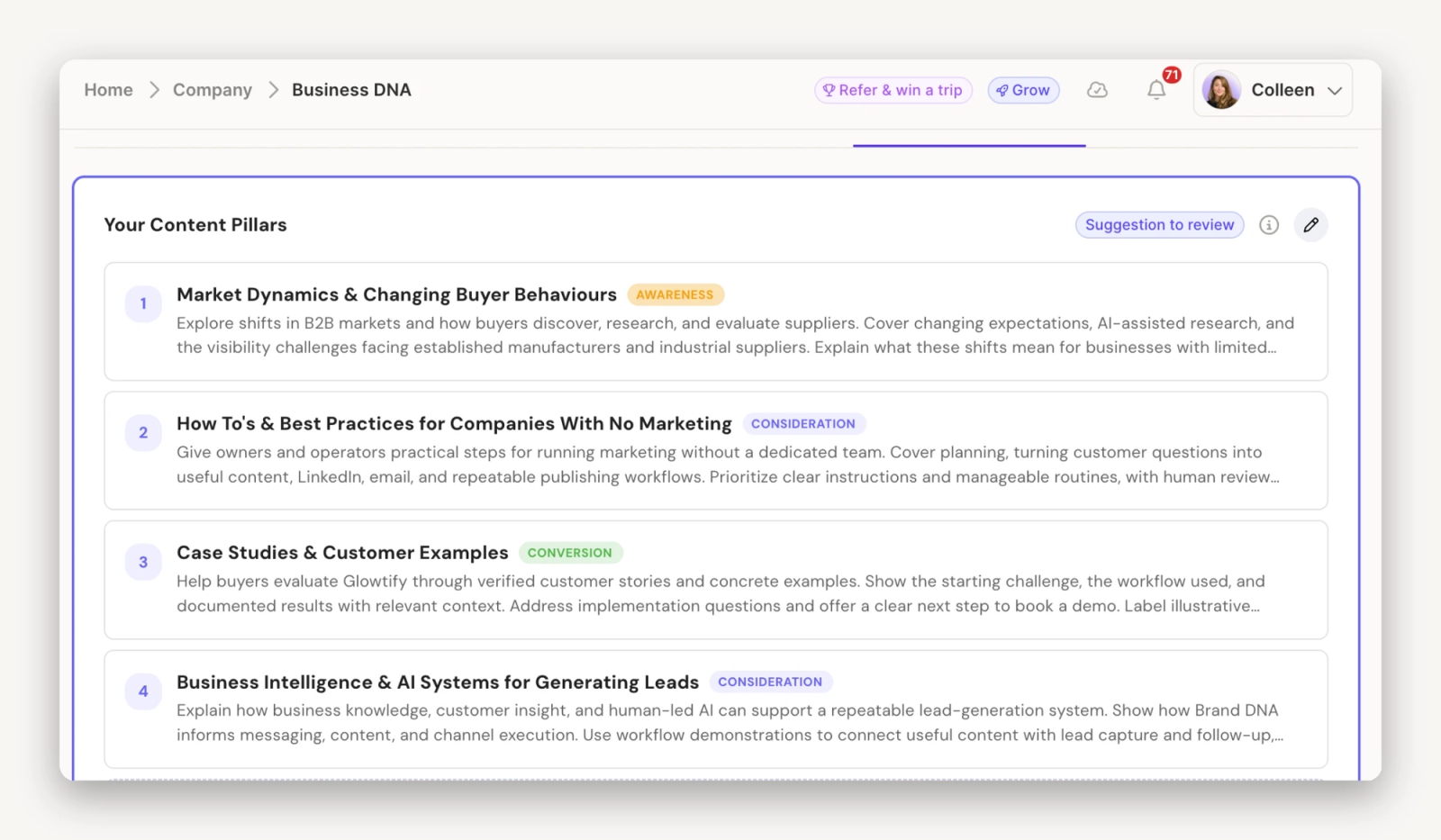
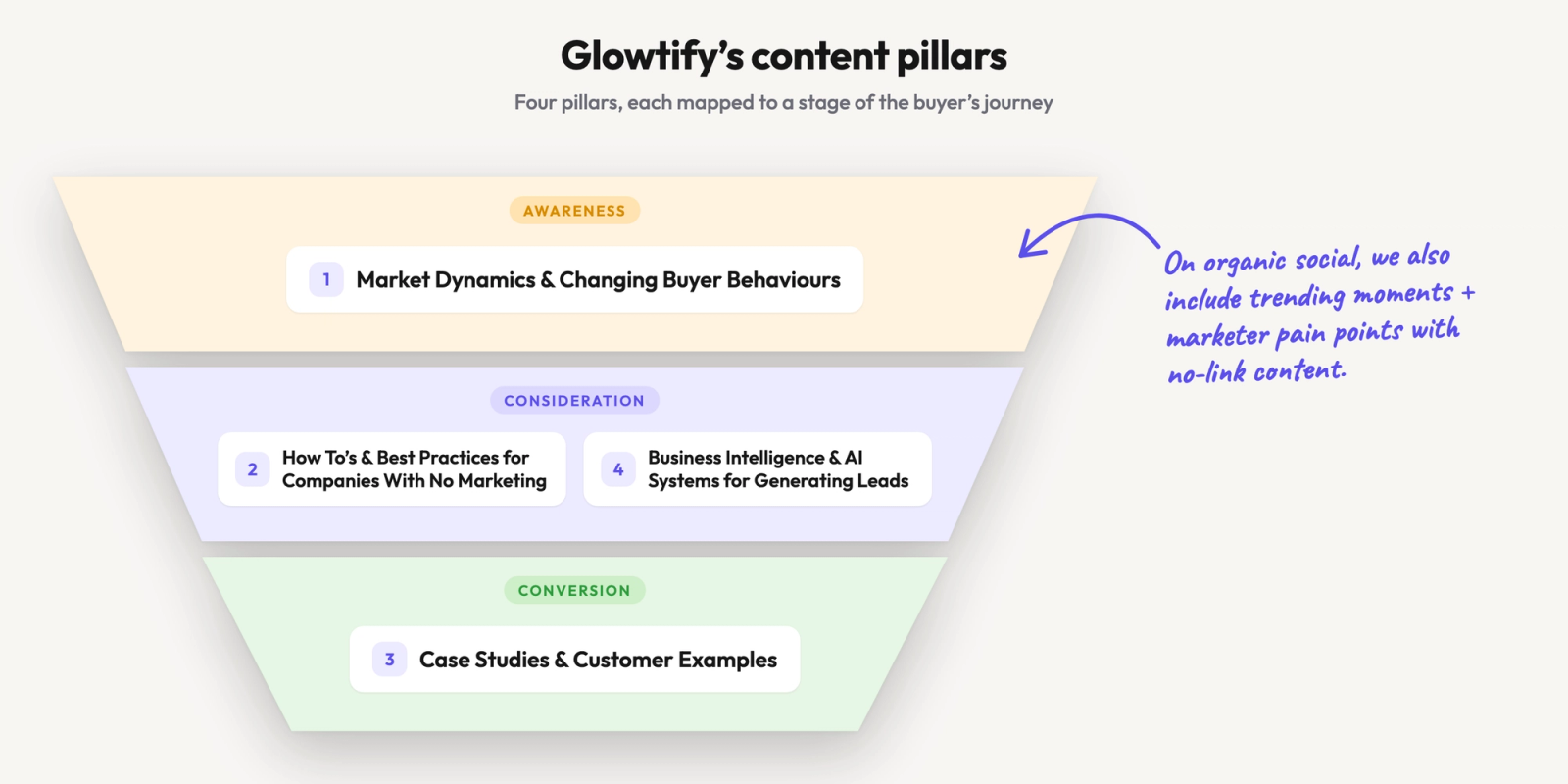
Here’s how we did it at Glowtify. We follow the same idea, with each pillar tied to a stage of the buyer’s journey, but we use four pillars, with two at the consideration stage:
- Market Dynamics & Changing Buyer Behaviours (awareness): how B2B buyers now discover, research, and evaluate suppliers, including with AI tools, and what that means for manufacturers and industrial suppliers.
- How To’s & Best Practices for Companies With No Marketing (consideration): practical steps for running marketing without a dedicated team, from planning to turning customer questions into content. This article belongs here.
- Business Intelligence & AI Systems for Generating Leads (consideration): how business knowledge, customer insight, and human-led AI can support a repeatable lead-generation system.
- Case Studies & Customer Examples (conversion): customer stories that show the starting challenge, the workflow used, and the results.
Each pillar answers a different question a buyer has on the way to a decision. That’s a useful test for yours: if two pillars answer the same question, merge them. If you want the simpler three-pillar version, our pillars 2 and 4 would be the ones to combine, since both serve buyers who are comparing options. You’ll also see the content types from earlier inside each pillar: pillar 1 leans on what-is content that explains market shifts, pillar 2 is mostly how-to content, pillar 4 uses guides that walk through a complete system, and pillar 3 uses case studies for buyers close to a decision.
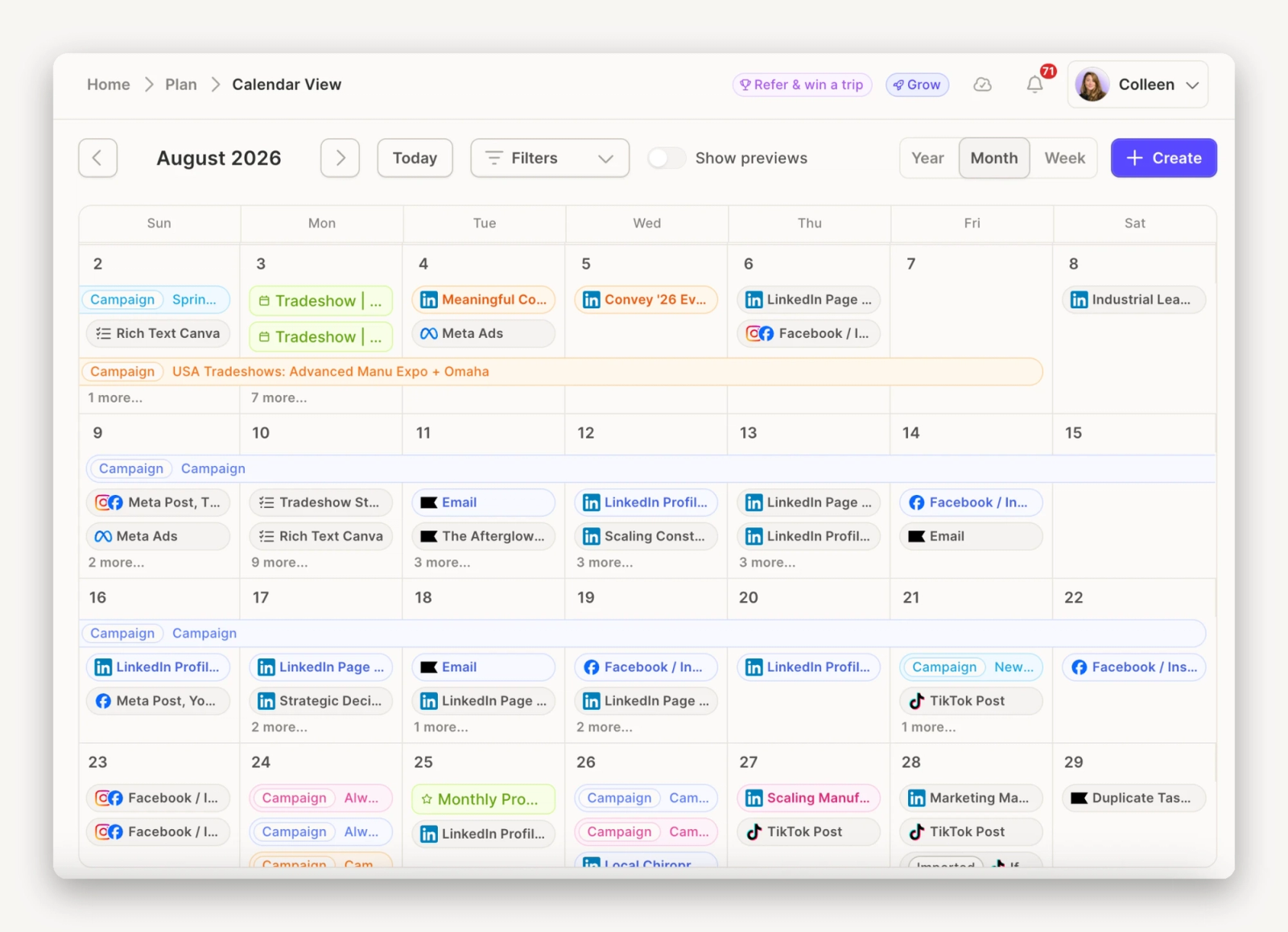
You can also look at content pillar examples when you are not sure where to start. Do not copy another company’s pillars—use them as a guide to see how they group their content around a few core topics. If you need help organizing your marketing direction, Glowtify’s marketing strategy feature can help your team turn core topics into a more structured plan. Once the pillars are clear, your team can use Glowtify’s content calendar feature to organize what it plans to publish under each one.
What to Publish Under Each Pillar
Once you have chosen your pillars, the next step is to turn each one into actual content. Each pillar should have several related topics under it, so that you are not publishing the same type of post repeatedly. For instance, if one of your pillars is how-to content, you can publish under it a tutorial, social post, or short video. If your pillar is a what-is content, you can publish under it an educational blog, FAQ, or infographic.
You can also produce content focused on your customer’s needs. Think about the questions your clients often ask. Write content that provides new knowledge or introduces your audience to a new product or service. You can also compose a piece that answers specific questions about an offering. This gives you a mix of content that not only attracts new visitors but also encourages them to purchase.
Bear in mind that you do not need to use the same format for every pillar. Choose the formats that make sense for your goals, audience, and available resources. You can also repurpose a topic into different formats. This can help even a small team get more content from the work it has already done.
When to Change a Pillar
Content pillars change as your goals, audience, products, and services change. This is why you need to be adaptable. For instance, if one of your pillars consistently gets little engagement, it may be time to consider changing your content. The same goes for when another pillar no longer matches your customers’ needs. Moreover, if your team is struggling to find enough useful topics within a pillar, it may be time to change your strategy.
Remember, however, that you do not need to remove all the content connected to a pillar if it needs to be changed. Review the existing content first, as some pieces may still bring traffic or conversions. Retain the content that continues to support your strategy, and focus only on the content that needs to be updated, redirected, or replaced.
How to Track Content Pillar Performance
When reviewing performance, look at the results for each pillar rather than only looking at your overall content performance. This can show you which topics are bringing in sales and which ones need more work. You should also give a pillar enough time to produce results before deciding to change it. Look at trends over time instead of judging a pillar based on one post. This gives you a clearer picture of whether the topic is working for your business and audience. So how do you track your content pillar performance?
The performance of your content pillars should be determined by your goals and website performance metrics, or key performance indicators (KPIs). You should already have these metrics for your content marketing, so review these to see if they are still relevant. Examples of KPIs are:
- Organic traffic
- Search engine ranking
- Conversion rates
- Engagement rates
- Revenue or sales
Google Analytics is a great tool for measuring performance across channels, while a platform like Glowtify can track the performance of your content marketing and offer optimizations based on content pillars.
Conclusion
Content marketing is an effective way to attract prospects and connect with customers.
But you need a strategy to make an impact, particularly when there’s so much content out there and so many brands looking to make an impact on consumers.
So whether you lead marketing or simply ended up owning it, developing content pillars will help you create relevant, valuable, and tailored content that ranks on search engines, without starting from a blank page every week.